• Campus Development

National Growth Fund Invests in Work Landscapes of the Future at Innovation District Delft

Innovatiedistrict Delft joins the National Growth Fund programme “Work Landscapes of the Future” as a Living Lab to accelerate climate-adaptive, energy-neutral and sustainable development of TU Delft Campus and Schieoevers toward 2030.

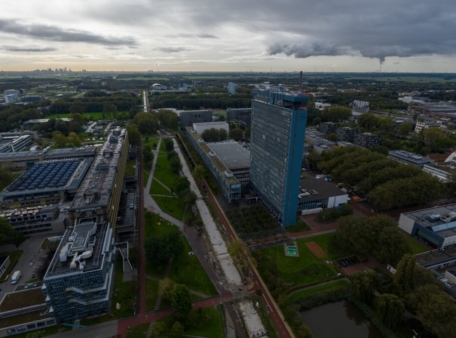
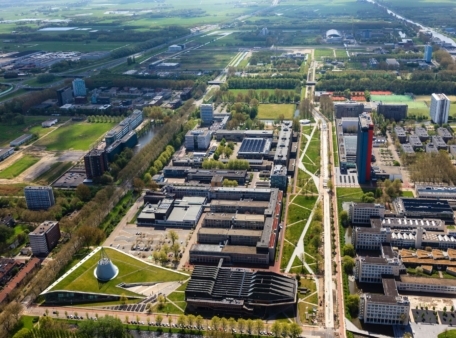
Campus van boven gezien

Innovationdistrict Delft is delighted with the allocation from the National Growth Fund through participation in the “Work Landscapes of the Future” program. The objectives of the program align seamlessly with the ambitions of the district.

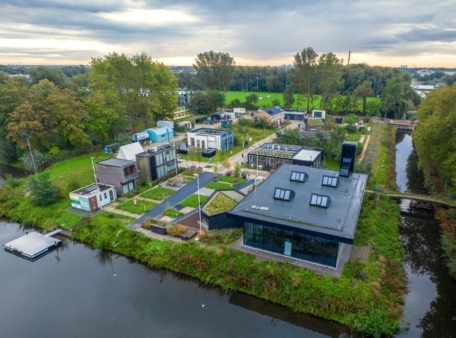
Innovationdistrict Delft is a collaboration between the Municipality of Delft, Technical University of Delft, Bedrijvenkring Schieoevers, the Province of South Holland, and the Metropolitan Region Rotterdam The Hague. By participating as a “Living Lab” in the Work Landscapes of the Future program, the area—including TU Delft Campus South and the Schieoevers-Zuid business park (adjacent to the TU Delft campus)—will explore opportunities for further development. This is a chance to better connect and strengthen the unique business environments of Schieoevers and the Campus within the larger context of Innovatiedistrict Delft and its surrounding landscape.

Catalyst for Delft’s Development
Jeanet van Antwerpen, program director of Innovationdistrict Delft, sees this as an excellent opportunity to leverage the existing collaboration in Innovationdistrict Delft, between Bedrijvenkring Schieoevers and TU Delft, with support from the Municipality of Delft and other stakeholders, to further shape the Living Lab. “We see the Living Lab as a catalyst for improving the quality of the environment for entrepreneurs, employees, students, researchers, residents, and visitors. This involves creating an attractive, healthy, and future-proof environment through climate adaptation and the use of sustainable energy. Achieving this requires smart integration and doing more on the same surface area, demanding creativity, entrepreneurship, and the application of innovation and tailor-made solutions from all stakeholders. The Living Lab helps us achieve that.”

TU Delft aims to be carbon neutral, circular and climate adaptive on campus by 2030. In doing so, TU Delft is also contributing to a highquality living environment for people and animals, with a specific focus on biodiversity, safety, health, inclusivity and happiness. The TU Delft EcoCampus team, consisting of policy advisors, researchers, (green)managers and students, among others, is working on realising the ambitions surrounding climate adaptation and biodiversity.

Bedrijvenkring Schieoevers (BKS) and the Municipality of Delft have been collaborating for several years through various programs and projects to promote sustainable development in the area. Developing Schieoevers as a showcase for technological innovation and sustainability on business parks is a guiding principle of the covenant the two parties signed years ago. The Living Lab represents the next step, emphasizing closer collaboration with TU Delft. BKS sees particular opportunities in health and energy transition.

CO2-Neutral and Climate-Adaptive by 2030
The ambitions for TU Delft Campus—a 160-hectare site with roughly 60 TU Delft buildings, including educational facilities, communal amenities, student housing, laboratories, field labs, sub-buildings, and company premises—are substantial. Around 250 companies are also located on the campus, with more than 30,000 people present daily, including students, staff, and visitors.

Hubert Linssen, Program Manager for Sustainability & Smart Campus at TU Delft, is pleased with the award: “TU Delft and Bedrijvenkring Schieoevers thus contribute to the further development and standardization of a climate-adaptive, energy-neutral, nature-inclusive, and therefore healthy work environment for Europe. The unique aspect of a Living Lab is that research testing and validation directly contribute to an inspiring meeting place in active collaboration with TU Delft staff and students, company employees on campus, and local residents.”

Tim Tabak, EcoCampus policy developer, sees major opportunities in the 2030 CO2-neutral and climate-adaptive objectives. “The ambitions of the Work Landscapes of the Future program align with our Campus Vision, which includes creating a campus that facilitates cross-pollination between knowledge institutions and companies.”

Hans Kuijpers, BKS board member responsible for clean, sustainable, and safe initiatives, adds enthusiastically: “BKS has long encouraged its members to think about the future of the business park and to invest in sustainable applications within their companies—such as solar panels, LED lighting, water pumps, green roofs, water storage, and energy exchange. We also work intensively with the Municipality of Delft on developments such as a smart grid and local energy management. Support from the Work Landscapes of the Future program can bring the realization of our ambitious goals closer. We are therefore very pleased with the National Growth Fund allocation.”

ingezoomde paarse swoop
paarse swoop

Subscribe to our newsletter

And we will keep you up to date about the campus news
Get Social